
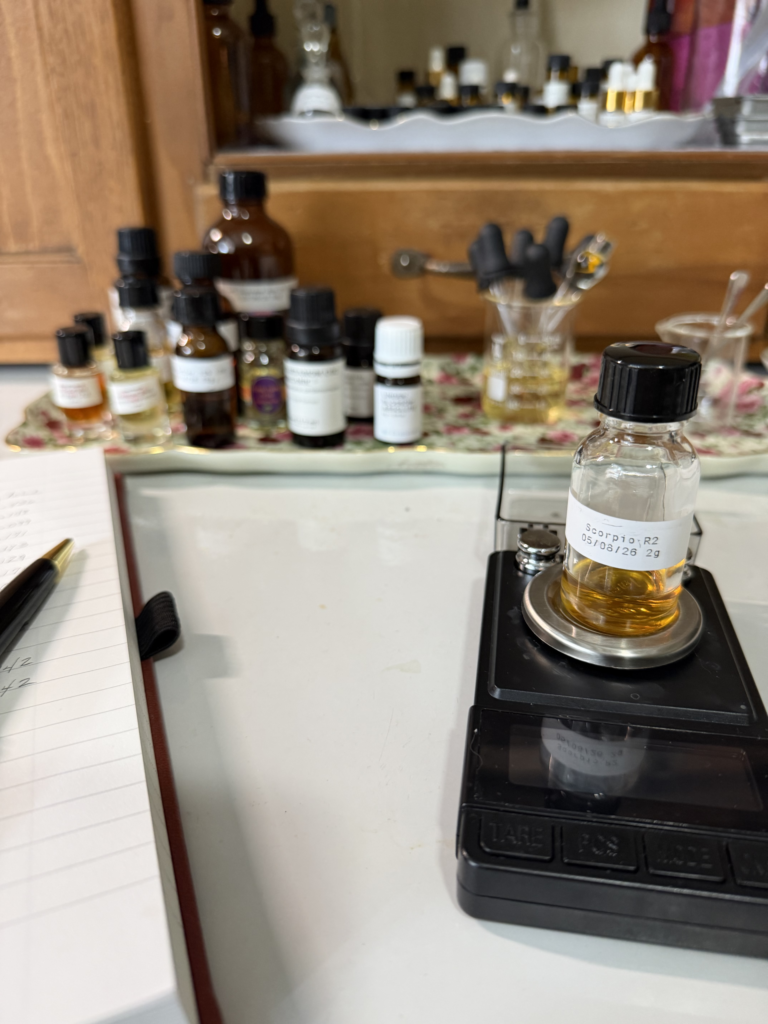
There is something wonderfully unpredictable about working with natural perfume.
When I open a bottle of rose absolute, frankincense, jasmine, sandalwood, or bergamot, I am not working with a single aromatic molecule engineered to smell precisely the same each time. I am working with a complex botanical material born from a living thing.
Its character carries the imprint of where and how it grew—the soil, rain, sunlight, climate, harvest, and distillation. Even different harvests of the same botanical can reveal subtle differences.
This is part of what I love most about natural perfumery. Natural perfume is alive.
Natural vs. Synthetic Fragrance
Modern perfumery has access to an extraordinary palette of synthetic aroma materials. They offer perfumers consistency, predictability, projection and effects that may be difficult—or sometimes impossible—to achieve using botanical materials alone.
A synthetic aroma molecule can be remarkably precise. Once a perfumer understands its character and behavior, it provides a reliable building block from formula to formula.
Naturals behave differently.
An essential oil or absolute may contain dozens or even hundreds of naturally occurring aromatic compounds interacting with one another. As the fragrance warms on your skin and its most volatile molecules begin to evaporate, what you perceive continually changes.
That is why traditional perfume compositions are often described in terms of top, heart, and base notes.
The top notes introduce themselves first: bright citrus, herbs, delicate aromatics and other fleeting materials.
As they fade, the heart begins to emerge—the florals, spices and other notes that give the perfume much of its personality.
Finally, the base remains: woods, roots, resins, mosses and other slow-moving materials that anchor the composition.
A natural perfume therefore isn’t simply a scent.
It is an unfolding experience.
What you smell in the first thirty seconds may be quite different from what you discover fifteen minutes later. Two hours later, you may find something else entirely waiting close to your skin.
The Intimacy of Natural Perfume
If you are accustomed to conventional fragrance, natural perfume may initially surprise you.
It generally doesn’t announce your arrival from across the room.
Natural fragrances tend to remain closer to the body, creating a more intimate scent experience. Someone may discover your perfume when they embrace you, lean toward you in conversation, or simply enter your personal space.
To me, that intimacy is part of their beauty.
Scent also has an unusually direct relationship with the parts of the brain involved in memory and emotion. A fragrance can alter how a moment feels—calming us, awakening us, grounding us, or unexpectedly carrying us back to another place and time.
Within my own energetic and Hermetic practice, I take that idea one step further. I work from the understanding that our inner state influences the energy we carry into the world around us.
So I don’t necessarily want my perfume to enter the room before I do. I want it to change how I enter the room.
If a fragrance helps me feel grounded, sensual, joyful, powerful, or peaceful, I carry that state into my interactions with others. In energetic terms, I think of this as a shift in the aura; in everyday terms, you might simply call it presence.
Either way, there is something beautiful about wearing a fragrance that is experienced first by you—and then through you.
Why Natural Perfume Takes Time
Creating with naturals requires patience.
When I first combine a formula, I don’t always know exactly what the finished perfume will become.
The materials need time to marry and settle. I may evaluate a new blend after 24 hours, but more complex compositions can continue developing for weeks. Often I will allow a perfume to mature for 30 days or longer before deciding that its character has fully revealed itself.
Then there is another variable:
You.
Temperature, skin chemistry, application, and environment all influence the way a fragrance develops. The same perfume can reveal different facets on different people—and sometimes even on the same person under different conditions.
This is why I think of natural perfumes as having personalities rather than simply scent profiles. You get to know them.
What About Becoming “Nose Blind”?
Have you ever worn a favorite perfume so frequently that eventually you could barely smell it—while everyone around you certainly could?
This is commonly called becoming “nose blind.” More technically, it involves olfactory adaptation: our sensory system reduces its attention to a persistent, familiar stimulus.
It isn’t unique to synthetic perfume; our sense of smell can adapt to natural aromas as well. Have you ever returned home after a long trip and suddenly noticed the distinct scent of your own house—the very scent that greets every visitor, yet normally goes completely unnoticed by you? That is olfactory adaptation at work – your brain has learned to quietly tune it out.
But one of the things I find captivating about complex natural compositions is how frequently they give the nose something new to discover as they develop. The brighter molecules disappear, the heart changes shape, the base emerges, and warmth and movement continually influence what reaches your nose.
Rather than experiencing one dominant effect for hours, I find myself repeatedly returning to a natural perfume and asking:
What are you doing now?
That ongoing conversation is part of the pleasure.
Why Doesn’t Natural Perfume Last as Long?
Longevity is one area where conventional fragrance often has an advantage.
Modern perfumers can use long-lasting aroma molecules and fixatives specifically chosen for persistence and diffusion. Natural perfumers have a more limited palette.
We traditionally build longevity through materials such as sandalwood and other woods, resins, roots, balsams, mosses and natural animalic materials. These slower-evaporating essences help anchor the more fleeting notes of a composition.
Even so, many completely natural fragrances will not perform like a conventional perfume engineered to remain perceptible all day. And that’s okay!
Depending on its composition and concentration, a natural fragrance may remain noticeable for several hours, while a citrus- or floral-forward composition may fade much sooner and a resinous, woody perfume may linger considerably longer.
Natural perfume invites reapplication.
A small bottle becomes something you carry with you—a moment to stop, breathe, anoint yourself and consciously reset during the day.
That can become a ritual in itself.
Spray, Solid or Oil: What’s the Difference?
Natural perfume can be expressed in several forms, and the medium changes the experience almost as much as the formula itself.
Alcohol-Based Perfume
Often associated with the traditional European or French style of perfumery, alcohol-based perfumes dissolve aromatic essences in high-proof perfumer’s alcohol.
Alcohol evaporates rapidly, allowing the most volatile aromatic molecules to lift beautifully from the skin. For this reason, sprays generally provide the brightest opening and greatest diffusion of the three styles.
If you love the sparkle of citrus, delicate florals and aromatic top notes, alcohol allows them to shine.
Solid Perfume
Solid perfumes combine aromatic essences with oils and waxes—often jojoba and beeswax—to create a soft balm that melts into the skin.
The wax and oil slow diffusion, making the fragrance softer, quieter and exceptionally intimate.
I especially love solids in the evening.
There is something almost ceremonial about touching a small amount to the pulse points before bed. Rather than filling the space around you, the fragrance becomes a private aromatic cocoon.
Oil Perfume & Attars
Oil perfumes occupy a beautiful space between the two.
Traditional Middle Eastern attars are aromatic compositions historically associated with materials such as sandalwood or agarwood, while contemporary oil perfumes may use neutral carrier oils such as fractionated coconut, jojoba or camellia.
For my own oil-based perfumes, I particularly enjoy fractionated coconut oil because it allows the fragrance to remain expressive without overwhelming the more delicate top notes.
Oil perfumes also make wonderful roll-ons: portable, intimate and perfect for travel or reapplication throughout the day.
Choosing Your Perfume
There really isn’t a “best” format.
There is only the experience you want.
Choose an alcohol spray when you want brightness, movement and greater diffusion.
Choose a solid when you want something soft, intimate and contemplative.
Choose an oil or attar when you want the ritual of anointing, close-to-skin wear and the convenience of carrying your fragrance with you.
But whichever form you choose, remember that wearing a natural perfume is a little different from wearing conventional fragrance.
Don’t expect it to remain frozen in the moment you first apply it.
Give it your skin.
Give it warmth.
Give it time.
Notice what appears—and what disappears.
Let it evolve with you throughout your day.
Because perhaps the most beautiful thing about natural perfume is that it doesn’t simply ask, “How do I smell?”
It invites another question:
“How do I feel?”
And sometimes, changing how you feel is enough to change the energy of an entire room.